It is perhaps one of the most recognizable symbols on the planet: a pentagon, usually yellow, with a stylized “S” in the center. Although it did not appear in this form from the beginning, the “S” has always been present on the chest of the character created by Jerry Siegel and Joe Shuster. Since then, its meaning, origin, and even its connection to the name “Superman” and the costume itself has changed over time. On some occasions, the emblem’s existence has even preceded the public adoption of the name by our esteemed reporter from Metropolis.
Broadly speaking, the symbol’s origin falls into two main categories: Earth-based and Kryptonian, though some stories across various media blend both approaches, while others ascribe to it more metaphysical meanings. Let us begin with the terrestrial origins:
I. The S Stands for Superman
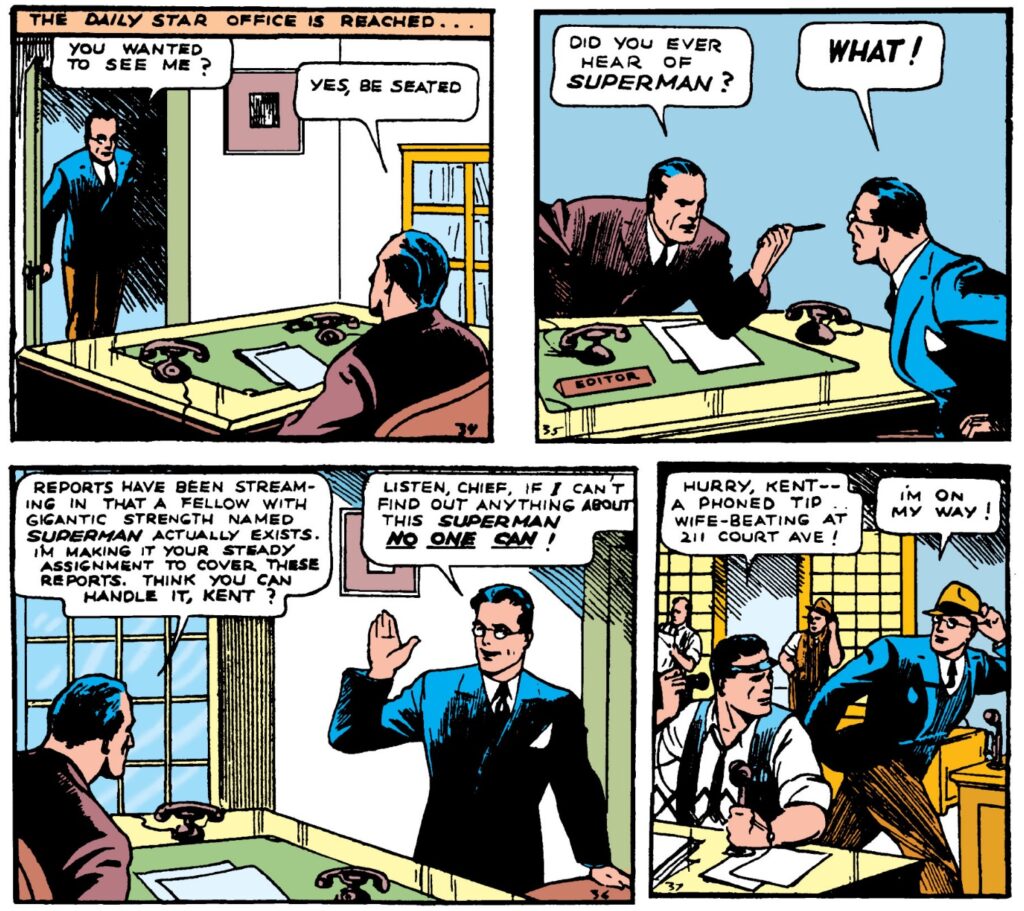
The very first time anyone refers to Kal-El as “Superman” occurs in Action Comics #1, when the editor of the Daily Star asks Clark Kent whether he knows anything about a man the press is calling “Superman.” There is little in this first appearance to suggest the origin of the emblem, and one can only assume it was simply an “S” chosen by Clark to represent his name: Superman.
In 1942, The Adventures of Superman by George F. Lowther was published. It holds the distinction of being the first book ever released about a superhero, and it introduced numerous foundational elements to the mythos of the Man of Steel. While Siegel and Shuster had already developed characters like Jor-L and Lora in newspaper comic strips, it was Lowther who greatly expanded the mythology and established the nomenclature Jor-El and Lara, now universally recognized as the spelling of Superman’s Kryptonian parents.
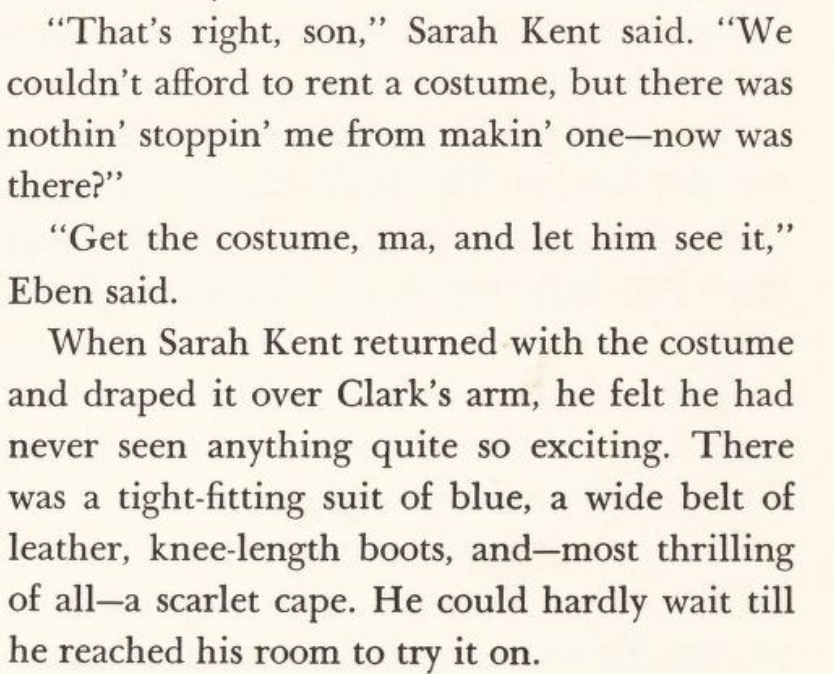
More importantly, Lowther firmly established the formative role of the Kents in shaping Clark’s moral compass. The Kents, formerly «a passing motorist», did not appear until the third retelling of Superman’s origin in Superman Vol. 1 #1, and Siegel and Shuster quickly wrote them off, having them die just one page later. In contrast, Lowther portrayed the moral integrity of the Kents—then named Sarah and Eben—what builds and transforms Clark Kent into Superman. Regarding the costume, Lowther wrote that Ma Kent crafted it for a costume party, as the couple was too poor to rent a suit.
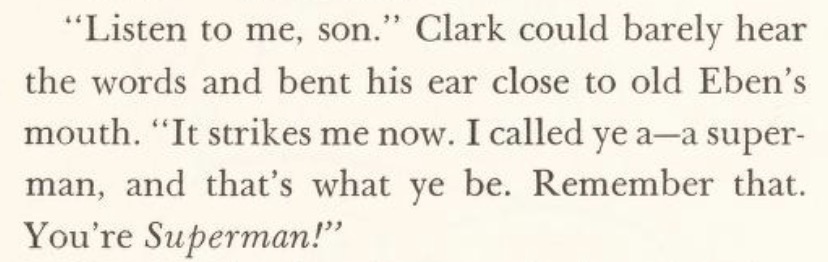
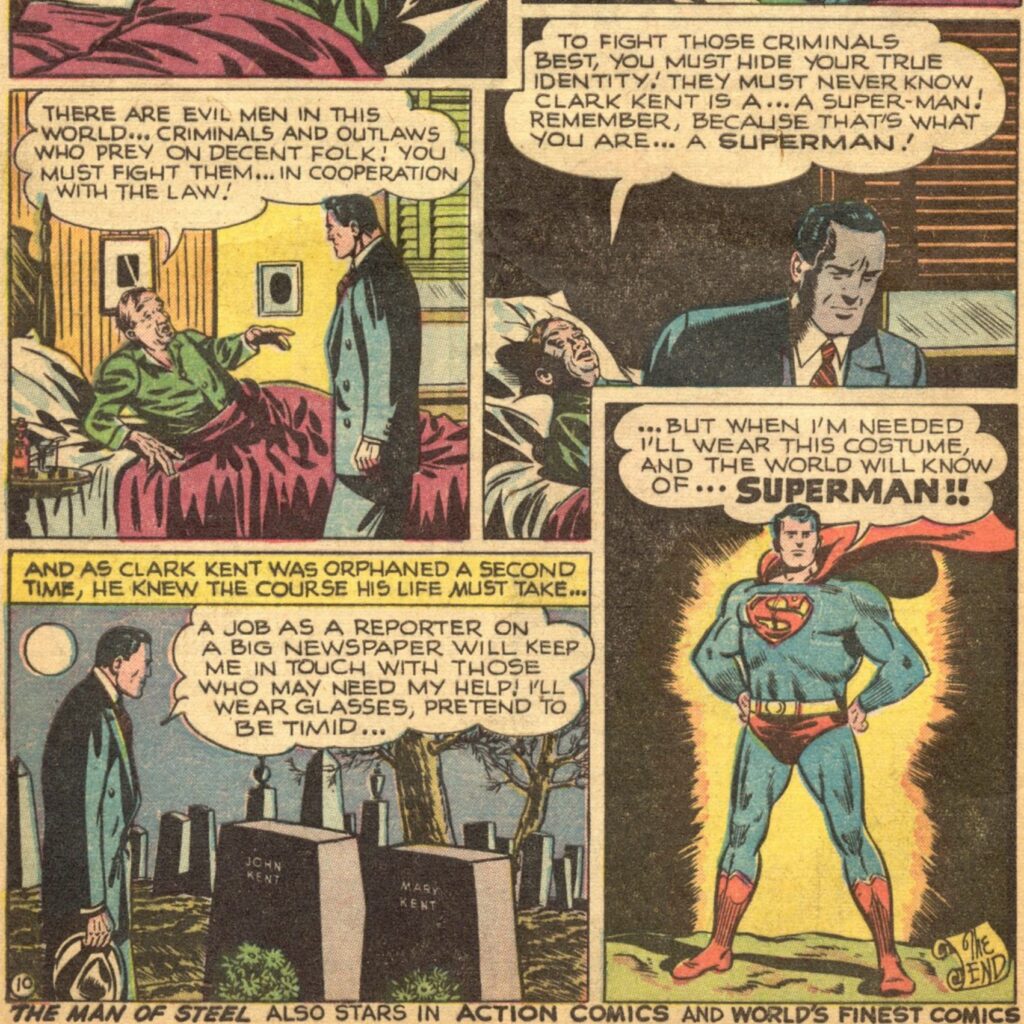
As for the name, Eben bestows it upon Clark before dying, urging him to use his powers for the good of humanity. Both the origin of the costume and the significance of Pa Kent’s death would become recurring elements in later iterations.
In this version, one can infer that the “S” was added to the costume once Clark arrived in Metropolis and began his heroic activities.
Meanwhile, in the comics, More Fun Comics #101 (1945) marked the debut of Superboy—one of the earliest attempts at franchise expansion through character variants. In that issue, we are explicitly told that Clark “secretly fashions a colorful red-and-blue costume” to create his Superboy identity.

It would take some time before the narrative unified Superman with his earlier career as Superboy. Thus, in 1948, Bill Finger and Wayne Boring reintroduced elements from Lowther’s novel in Superman Vol. 1 #53 and, for the first time, established that “Clark” was Ma Kent’s maiden name.
Though by this time no stranger to adaptations, in both the radio serial The Adventures of Superman (1940) and the Fleischer cartoon Superman (1941), little is said about the origin. The radio show introduces Superman as an adult emerging from the rocket that brought him to Earth. In the 1948 15-part live-action serial Superman, starring Kirk Alyn, elements from Lowther’s novel are reused: Pa (Eben) gives Clark his name, and Ma (Sara) makes his costume.
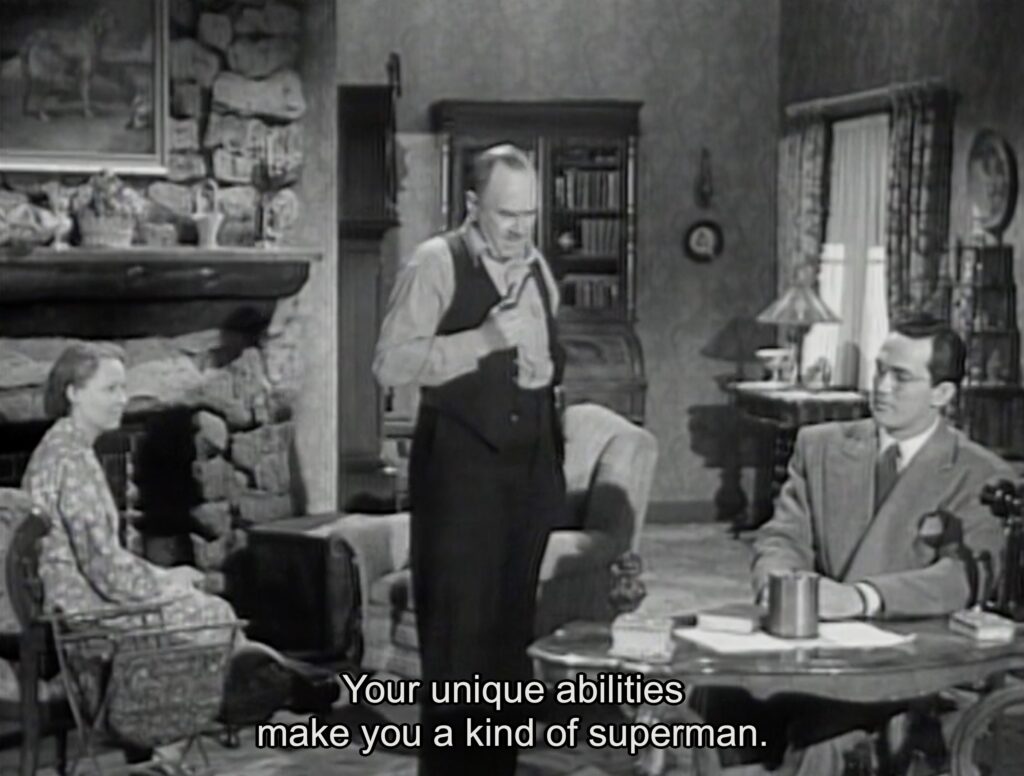
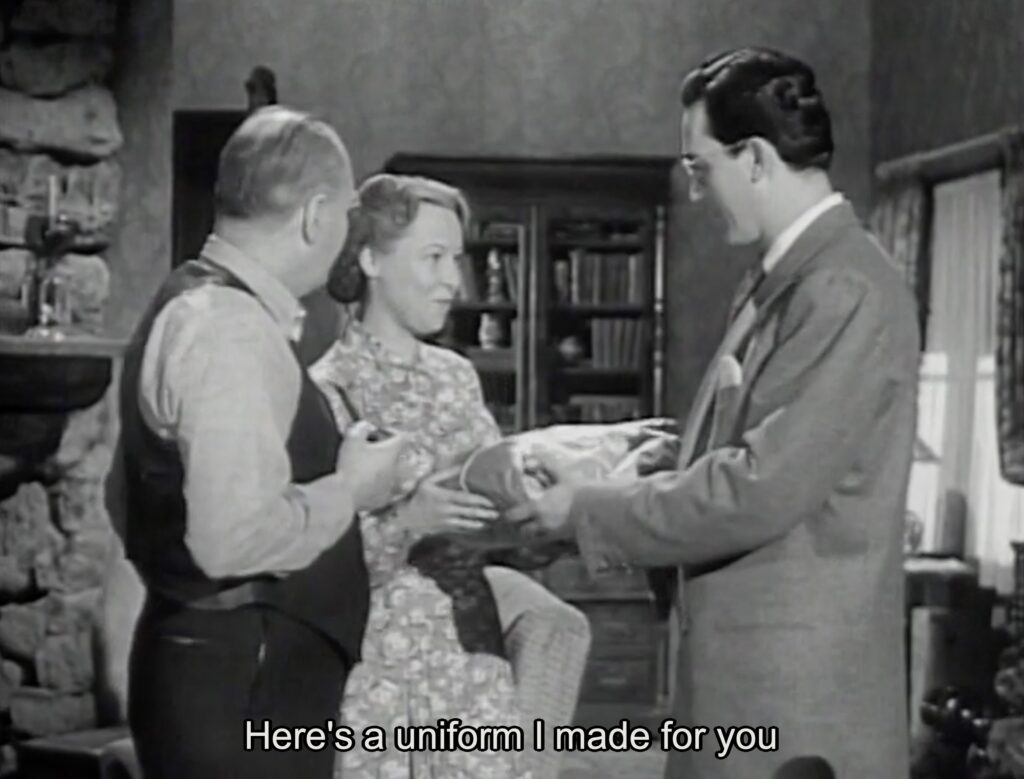

In the first episode of The Adventures of Superman, now starring George Reeves, several key elements are repeated: Ma Kent, we are told, crafts the costume, and for the first time it is revealed that, although the design is terrestrial, the suit itself is indestructible and made from baby Kal-El’s blankets, what would become a recurring element from this point on.
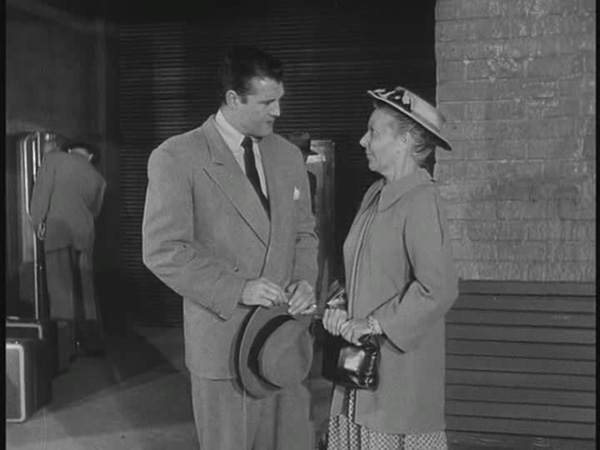

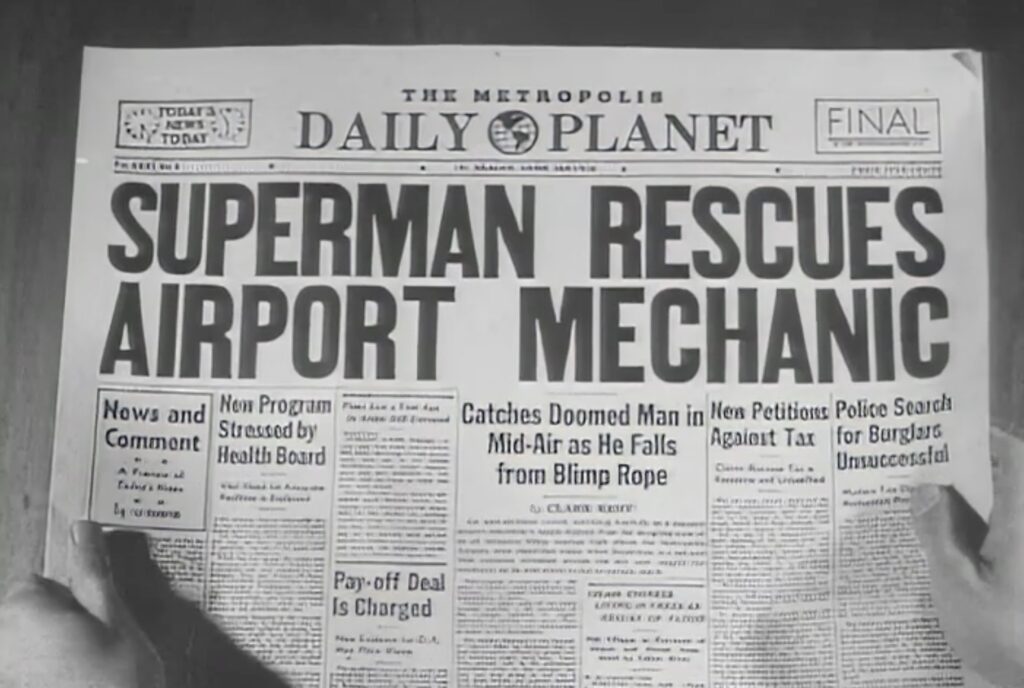
Superman first introduces himself while saving an airport worker dangling from a blimp. Clark refers to himself as “Superman” when writing the story of the incident.
In 1959, DC sought to expand the franchise by introducing Kara Zor-El, Superman’s cousin, hailing from Argo City—a Kryptonian city that survived the planet’s destruction. As Argo faced imminent doom, Kara’s father sent her to Earth wearing a suit and emblem inspired by Superman fashioned by her mother. Thanks to Earth’s transmissions, they were aware of his Kryptonian heritage. The familial connection was a fortuitous coincidence, discovered only later, upon their meeting.
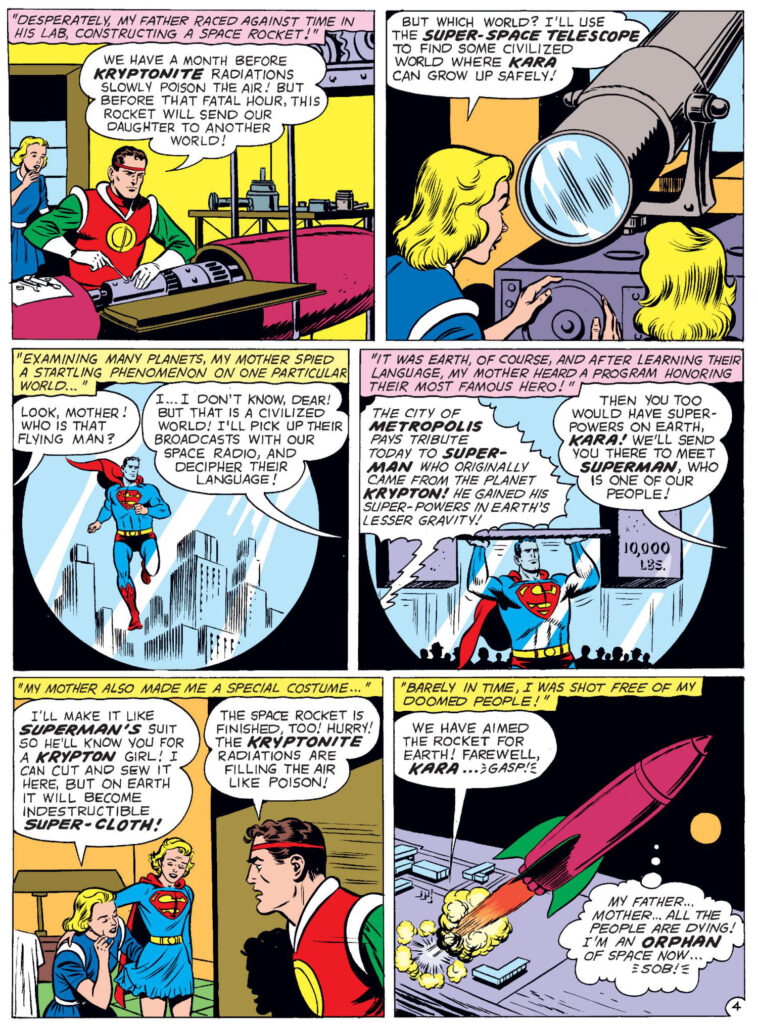
In Superboy Vol. 1 #78 (1960), the origin of the costume is recounted, marking the inaugural comic book depiction of the concept that it was crafted from Kal-El’s infant blankets. Additionally, young Clark elucidates the significance of the “S” emblem to himself.

This is the first instance in which the symbol and name are explicitly depicted as being created directly, with a specific focus on the design itself. In all previous iterations, it had been presumed that Ma—either alone or in collaboration with Pa—had designed the symbol prior to presenting it to Clark. Although this scene is not revisited in subsequent origin retellings (such as Superman Vol. 1 #146 or The Amazing World of Superman), it was considered canonical until 1979, when Martin Pasko and Curt Swan provided a comprehensive origin in Action Comics #500.

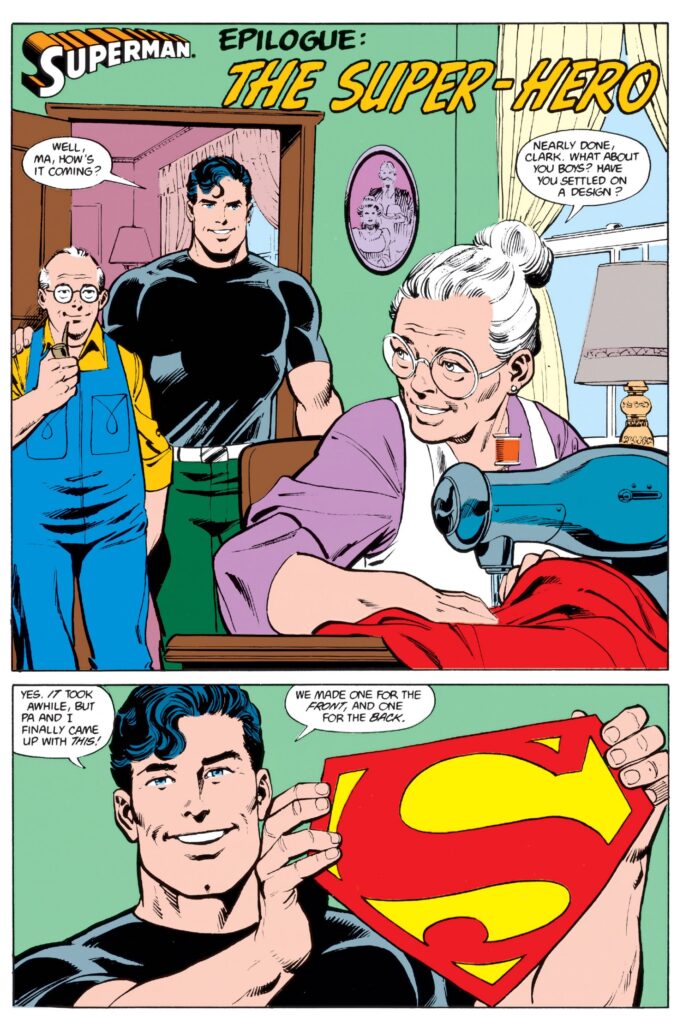
Following the Crisis on Infinite Earths reboot of DC’s comic universe, John Byrne was entrusted with revitalizing the Superman mythos. As part of his mission, he synthesized elements from various previous sources. While he appreciated the concept of Lois naming Kal-El “Superman” in Superman: The Movie, he disapproved of the Kryptonian origin of the symbol. This posed an ontological dilemma: if Lois had created the name, how could the emblem already exist?
In a remarkable display of innovative thinking, Byrne had Clark perform his inaugural heroic act in civilian attire. This freed Ma Kent to sew the suit subsequently, while Pa and Clark collaborated to design the symbol after his debut— as depicted in Man of Steel #1 (1986):
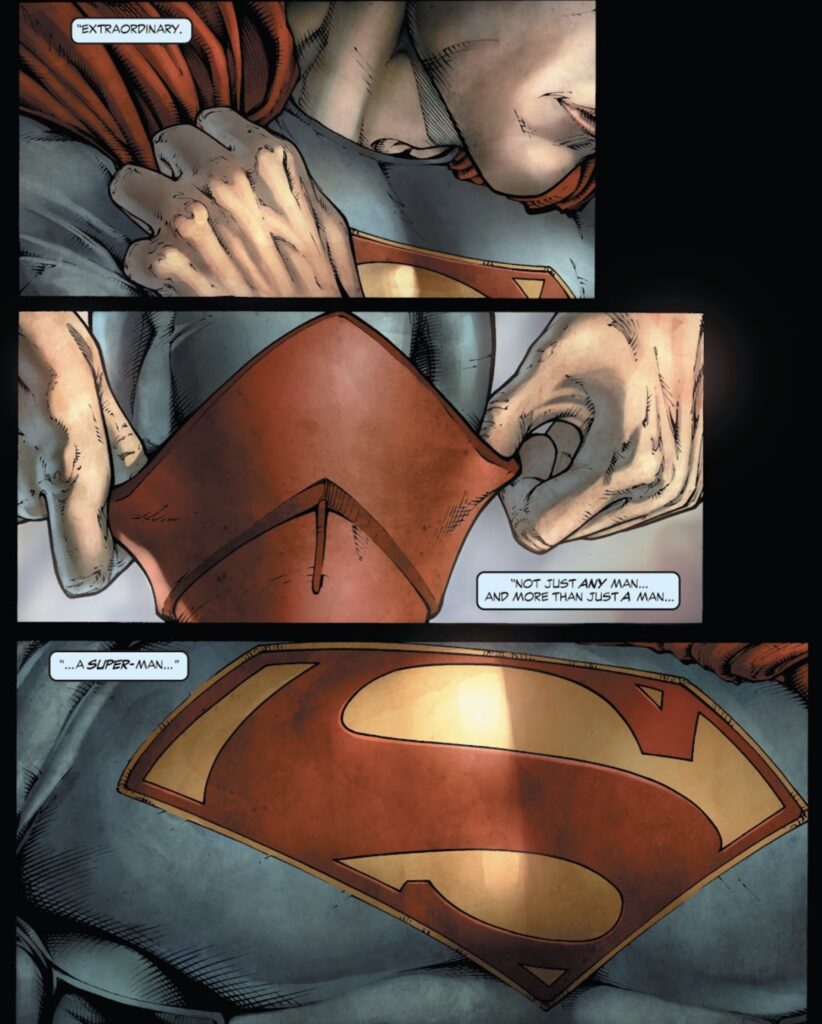
In 2010, J. Michael Straczynski streamlined the sequence further in Superman: Earth One. Ma and Pa Kent created the symbol, although they disagreed on its meaning: for Ma, it meant “Son,” while it was once again Pa who gave him the name “Superman.”:

Despite some variations in the details, for the initial six decades of Superman’s publication history, a consistent element persisted: the creation of the “S” emblem on Earth by the Kents, as a response to the query regarding Clark’s intended use of his powers. This trajectory underwent a transformative shift when the author of The Godfather presented the creators of Superman with an offer the couldn’t refuse.